
Author: Mikee Jane Angeline Baldomir
Failure
Lack of Motivation
Premised on Advice from Grown-ups
When you watch The Graduate, do you identify with the parents? Do you grow impatient scrolling to your birth year in online drop-down menus? Is a night of continuous, unmedicated sleep one of life’s greatest pleasures? If so, Pamela Druckerman says, you might be in your 40s.
Druckerman thought that being in her 40s would be a “delicious secret.” But, it turns out, others noticed, too. Salespeople steered her toward anti-aging creams. Her daughter observed: “Mommy, you’re not old, but you’re definitely not young anymore.”
So she decided to write about this “confusing place in the lifespan.” Druckerman’s new book is called There Are No Grown-Ups: A Mid-Life Coming-of-Age Story.
Druckerman has lived in Paris for the last 14 years. Her 2012 book Bringing Up Bébé observed cultural differences in parenting in the U.S. and France. In her new book, she explores the French approach to aging. (Writing a book about being in your 40s while you are inyour 40s is “quite a ‘meta’ way to age,” Druckerman says.)
Being 40, she found, isn’t about meeting any big milestone — it’s an “accumulation of lots of small experiences.” Druckerman took careful notes on her own experience, and shares her observations on a decade Victor Hugo called “the old age of youth.”
Rooted on Social Triggers
So, you want to build your confidence?
How do you do it?
And is it even possible?
About 10 years ago, when I was just starting college, I would have said, “there is no secret. You either have it or you don’t.”
And I would have been WRONG.
You see, back then, I had almost zero confidence.
But today I’m thinking about getting “unstoppable” tattooed on my forehead.
How did I develop my confidence?
The answer might surprise you…
Why Confidence Matters – in Business and in Life
But first, let’s be clear WHY being confident matters:
Whatever you want to do or achieve in life, success comes from taking ACTION. Or to quote myself…
Those who do nothing, achieve nothing. – Derek Halpern
…and I bet you’ll agree.
If you want to go on a date with someone, you have to ask them out.
If you want to get a raise, you have to ask for a promotion.
If you want to build your network, you have to be more social.
And if you want to build an audience, you have to step onto the stage.
Without action, no success.
Now here’s the thing…
The hard part isn’t knowing WHAT to do. The hard part is actually doing it. And that’s where confidence makes all the difference.
Because when you lack of confidence, you don’t take action…
You want to speak up in a large group. But you stay silent because you’re afraid to get shut down.
You want to meet new people. But you’re too shy to start a conversation. Or you’re just worried that people will think you’re weird.
And it’s a shame. Most people don’t do the things they want to do. Not because they don’t know how. Not because they’re not smart enough… but because they lack the confidence.
It’s time to change that. And I have good news:
With just a few simple hacks, you can build your confidence every day and reach level “unstoppable” too.
Confidence Leads to Action, Action Leads to Success
Confidence is like the granddaddy of all self-development…
When you’re confident you stop feeling self-conscious about your quirks.
When you’re confident you stop worrying about what everyone else thinks and stop second-guessing your decisions.
When you’re confident you can face your big fears. Whether it’s something specific like becoming better at public speaking…
…Or simply going ALL IN and following your dreams.
In short, confidence is the difference between thinking about doing something… and actually doing it. And that’s why it’s so important for success – in all areas of life.
Especially when it comes to business and selling. And even more so if you sell services, coaching, or online courses. And there’s science to back this up, too.
In particular, one study by Don Moore of Carnegie Mellon University shows that people are more likely “buy advice” from a more confident seller. The crazy part? It didn’t even matter if that seller had been wrong in the past.
So, if you want people to listen to you, take your advice, and ultimately buy from you, being confident is crucial.
But isn’t that just being a fake?
No…
Of course you shouldn’t pretend to know things you don’t know. You see, there’s a big difference between being confident and being an arrogant jerk…
What Does it Really Mean to Be Confident?
So what is self-confidence?
Some psychologist make a distinction between self-esteem and self-confidence. But for our practical purpose here, it’s not important. So I’ll just talk about self-confidence.
Being confident means two things:
- You believe that you deserve to succeed
- You trust in your abilities to succeed
When you have both of those things, you can act with confidence.
As you can see from the definition, confidence arises from INTERNAL sources – your thoughts and beliefs – as well as EXTERNAL sources – your abilities and skills.
Thoughts + Skills = Confidence (= Success)
And I’ll address both parts of that equation below.
But first, let me point out the difference between confidence and arrogance. Because that’s where a lot of people get stuck…
And here it is:
Arrogant people brag about skills they don’t have, to get confirmation from others, because they lack belief in themselves.
Whereas…
Confident people let their actions speak for themselves, because they have the mindset and skills to succeed.
As you can see, being confident is not about bragging. It’s not what you say at all. It’s about how you see yourself and how you carry yourself. And then, as a result, how you’re being perceived by others.
This is the FIRST thing you should remember, if you want to be more confident. And then you can stop humble-bragging, too…
…which is a terrible habit. For TWO reasons:
First, you’re still bragging.
Second, why are you trying to be so “humble” in the first place?
Just look at the definition of the word “humble:” It means having a “low estimate of one’s own importance.”
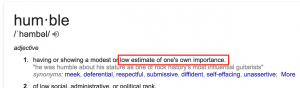
The sad thing is, I used to see myself that way. But it’s straight up destructive. No one should think of themselves as “of low importance.”
Alright, with all that said, let’s focus on developing real confidence…
The Secret to Becoming More Confident
How did I build my confidence?
The real answer:
I faked it.
That’s right. At first, I pretended to be confident. But I didn’t really FEEL confident yet. I just ACTED the way a confident person would act…
And what happened? Over time, I started to feel more confident, too. And before I knew it I became the confident person I always wanted to be.
And that’s the secret…
I call it the A-B-C Method of building confidence:
First you just ACT confident.
Then you BELIEVE you can be confident.
Finally, you just are… CONFIDENT.
As attested by The Positivity Blog
To stop being so lazy and get what really matters done by working smarter. While still having room for guilt-free lazy time to spend as I like.
1. Be kind to yourself.
When you feel that you’ve perhaps been too lazy lately it’s common and tempting to beat yourself up about it and to hope that will lead you to start taking action.
Sometimes it does. But I have found that beating yourself up most often just leads to feeling guiltier and like a failure. And so you feel less motivated to get going and you procrastinate because there seems to be little point in even trying.
Instead of getting stuck in that self-esteem sucking place I recommend to gently nudge yourself towards the next tip in this article whenever you feel like you want to beat yourself up.
2. Start with just a small step forward.
The hardest thing is often to simply get started.
So make that as easy as you can to reduce the inner resistance and to actually take action. Start with just taking a small step forward:
- Go out running for only 3 minutes.
- Do the dishes for 5 minutes.
- Write on that report you’ve been procrastinating on for 10 minutes.
I use this habit almost every day in some way. I’m for example creating a new course and my daily aim over the past months has usually been to write 1 page a day. And now that the writing is done the aim as I start my day is often to edit 1 page.
That’s it. But it has never stopped at only 1 page in these months, I have written or edited a whole bunch more each day.
3. Do a small part of what matters most first thing in your day.
To feel like you can enjoy your lazy/rest time fully and without guilt it’s important to actually get what truly matters in the long run done each week.
So start your day with that. But make it easy on yourself by breaking down that task into smaller steps and then focus on just the first one.
Get on it right away to get into an effective and focused mindset.
By doing so you set a good tone for your day. You get that quick 5-10 minute win in first thing and you’ll be a lot more motivated to keep going on that path during the rest of your day.
Instead of starting with busy work like checking emails – this may be vital to do first thing for some but for many it’s probably not – or checking Facebook etc. and then 30 minutes later getting started with today’s work.
4. Cycle fully focused work with small breaks of rest/lazy time.
To lighten up your daily work inject small breaks between doing short but focused burst of work.
Say to yourself: I’ll do 20 minutes of work on this task now and then I can take 5 or 10 minutes of lazy time.
By breaking down your hours like this the work seems less daunting. And you’ll feel energetic and motivated longer and do work of better quality if you allow yourself these pauses of rest and time to lazy around on Facebook, with a game or with just relaxing in the grass or with short walk in the park.
Then, after some time, you may want to work for 40 minutes before you take a 10 minute break. But go easy on yourself at first.
And if you have trouble with sticking to your time-limits then use an app on your phone or a simple egg-timer from your kitchen.
5. Shut down the escape routes temporarily.
Just sitting down at for example your computer and trying to do fully focused work for 5 or 20 minutes may not result in any work of importance getting done.
Not if you don’t remove those things that you usually use to procrastinate.
So ask yourself: where do I usually escape to instead of doing my work?
For me it’s for example often my smart phone and checking Reddit, Twitter or random internet browsing.
So I put my phone in silent mode and I put it at the other end of our home when I work. By setting up that small physical obstacle I avoid the phone trap maybe 95% of the time.
If you:
- Have the same issue with gaming then put your controller far away in your home while working.
- Escape to Facebook or other websites on your computer then block that for a little while by using for example StayFocusd.
- Watch TV then pull out the cords to it. Or remove one of the cords completely and put it at the other end of your home.
6. List the downsides and upsides for renewed motivation.
Asking yourself better questions tend to give better answers.
Two sets of questions that I have sat down and asked myself with closed eyes and that have refueled my motivation many times are:
- How will my life look in 5 years if I just continue to stay on the same path as now?
- How will life likely become worse for me and maybe even for the people around me?
This is not like beating yourself up but rather a sober examination of where it’s realistic that you’re heading. And it may be uncomfortable but try to see the negative consequences as vividly as you can in your mind to kickstart your motivation to get going for that positive change.
Then ask yourself:
- How will my life look in 1 year if I get started, stick with it and keep going with this change?
- How will life improve not only for me but for the people that I love if I stick with it?
7. Unclutter your life.
When your life’s too cluttered and overwhelming then you may shut down and procrastinate by lying lazily on the couch and just watching the TV or your smart phone.
When that’s the case then start uncluttering both your work hours and your private time. Two questions that have helped me to do that and to find what is most important are:
- What would I work on if I only had 2 hours for work today?
- If I had just 1 hour of free time today then how would I spend it?
Use these to get out of an old rut, to question your normal day a bit and to find your top priorities.
Then see what you can eliminate, minimize or perhaps delegate of the things that are not contained in your answers.
8. Be OK with stumbling from time to time.
The fear of failure can hold you back in a state of doing easier things and in what you may see as being lazy.
But everyone that go for what they truly want and outside of their comfort zone stumbles and fails from time to time. That’s just a part of a life well lived (even if we don’t hear about people’s setbacks as often as their successes).
See a setback as a learning experience and as a way to be more constructive and kinder to yourself.
You can do that by asking yourself these two questions after you’ve stumbled:
- What is 1 thing I can learn from this situation?
- How would my best friend/parent support me and help me in this situation? (Then talk to yourself and do things like she or he would).
9. Let the enthusiasm, energy and motivation of others in.
Whatever you let into your mind and life will influence you. If the people you hang out the most with are generally a bit lazy about work or school then it’s easy to just adapt to that mood and way of thinking and go with it.
But if you spend more time with motivated people in real life and via books, the internet, podcasts and audio books then that will start to influence your thinking and mood too.
So think about what you let into your mind on a daily and weekly basis and if you want make a few changes to that.
10. Truly appreciate and enjoy your lazy time.
Time spent on just lazying around helps me to relax and recharge and it makes me happy.
But if I do it too much then it does become less healthy for me. It:
- Starts to frustrate me because I’m not moving forward towards what I want.
- Creates stress instead of relaxing me because I’m not getting what’s important done and that could have negative consequences quite soon.
Still, at a moderate amount spending some time on being lazy is truly beneficial for me.
And I’ve found that when you think a little about how you want to spend your lazy time – no matter if it’s a 10 minute break or a lazy Sunday – and use that time on something you really enjoy like reading a book you love rather than aimlessly watching TV-shows you’re just OK with then that time does not only brings more happiness and fulfillment.
I’ve also learned that when I spend my lazy time in this more conscious way I’m more motivated and energized to go back to work again later on.
So I make sure to appreciate and fully enjoy the lazy time I have and create for myself because I know that it will benefit me in several important ways.
Here’s the next step…
Now, you may think to yourself:
“This is really helpful information. But what’s the easiest way to put this into practice, actually stick with it and not be lazy even when I’m really unmotivated?”.
As claimed by The times of India
Mother gives us Birth (Life) but, our teachers have given birth to our knowledgeable mind. You must be pondering why teachers scold you? You ought to know what a tough but fascinating and painstaking job teaching is. Strict teacher might see like a monster to you, but you cannot deny that she gives her all to make you a competent person. She trains you for the outer world. She shows her workmanship. She takes painstaking efforts to be strict with us even if she is a playful person. She is truly, truthfully the perfect person identical to God. You think she is a stern person but no behind her strict act is a kind person taking efforts to impart knowledge to us. Teachers are perfectly phenomenal. Don’t Feel Bad If A Teacher Scolds You
Adapted from Human Diseases
School failure is a process where a student slips farther and farther behind his peers and gradually disconnects from the educational system. The end result of school failure is dropping out before graduation. Many cases of school failure happen among students who have the ability and intelligence to succeed but who are unable or unwilling to apply these abilities in the school setting.
Students can begin the slide into failing patterns at any time during their school career, but school failure is more likely to occur at transitional stages, such as when graduating from elementary to middle school or after a family move to a new school system. Failing grades typically are symptoms of emotional, behavioral, or learning problems.
Why Do People Fail in School?
People who fail in school may feel “stupid,” but emotional or mental health problems and “hidden” learning disorders, not low intelligence, often are the root causes of their inability to meet the standards of a school. There are several factors that can lead to school failure, among them depression, anxiety, problems in the family, and learning disabilities.
Depression
Depression is one of the most common causes of school difficulties. It is a condition that can make people feel sad for long periods of time, have low energy, and lose interest in activities that normally give them pleasure. People with depression have continuing negative thoughts about themselves and the future, and they may experience changes in eating and sleeping patterns and in their ability to concentrate and make decisions. They may feel hopeless and may even think about suicide. Depression has been shown to be a leading cause of school failure in young people with learning disabilities. Depression can also cause school failure in students without learning disabilities.
Anxiety
Anxiety is a feeling of excessive worry about a possible danger or an uncomfortable situation that is intense enough to interfere with a person’s ability to concentrate and focus. Students can have genuine reasons to be anxious. People who have been bullied at school may worry that they will be bullied again. Students may legitimately fear personal violence on the way to or from school. They might worry about their families going through a divorce or about a parent who is ill. On the other hand, ordinary adolescent worries about looking right and fitting in can be blown so far out of proportion that a student may try to be
Teens with learning disabilities or who feel anxiety about school may neglect schoolwork for other distracting activities.
Peter Arnold Inc.
absent from school just to avoid a possibly embarrassing or uncomfortable situation. This is called “school avoidance.” Anxiety in any of its forms can interfere with a student’s performance in school.
Problems in the family
Students also may bring their problems at home to school with them. If a student’s family is experiencing violence, unemployment, alcohol or drug use by a family member, problems with the law, or any other upsetting experience, it can be difficult to concentrate on schoolwork. Many students who are having family problems might have trouble controlling their anger and frustration at school, and they may end up in trouble because of their behavior. Some students who are overburdened at home by circumstances that make it necessary for them to “parent” siblings, hold a job, or care for an ill or impaired parent may find it impossible to keep up. Many times students who face overwhelming family or personal problems keep these problems to themselves. School counselors can help support a student and prevent failure if they are made aware of the problem.
Learning disabilities
Learning disabilities are conditions that interfere with gaining specific academic skills, such as reading or writing. Learning disorders can hinder a person’s ability to concentrate or to process or remember information. When these difficulties are recognized early, certain teaching strategies can help a student overcome the learning disability. Unfortunately, many learning problems may go undiagnosed or may be diagnosed incorrectly as behavior problems. The frustration and depression that can result from undetected learning disabilities is a major cause of school failure or dropping out of school.
Other causes
Many social factors can increase the risk of school failure. These include homelessness, poverty, frequent moves from school to school, and the inability to speak English. Other circumstances such as truancy * , teenage pregnancy, and chronic illness * may also affect a student’s ability to do his or her best in school.
School Failure
In regard to Quora
You belittle someone when you say something (or, possibly act in such a way) that the worth of the other person or their work is diminished with malicious intent. Or, to put it less formally, you make the other person feel small.
The expression always implies a negative and unjustified attitude. “Belittling” is never just an evaluation or even a negative criticism. It is the latter, but with the additional intention of hurting another person.
The reason for belittling could stem from several different motives. [Please note that the issue I’m using as an example (my aptitude at making computer drawings) is not a “hot button” issue or a point of sensitivity to me.]
A. It could be just a matter of ill will. Let’s say that I create one of my little computer based drawings (using Paint Shop Pro 7 by Jasc). Someone looks at it and says, “That’s really quite amateurish.” Of course, it is. I’m an amateur. But why spout it to the world or directly to me for any reason other than to make me feel bad? My work, such as it is, has been belittled, and so have I.What does it mean to belittle by someone?
In reference of Neel Burton
Laziness should not be confounded with procrastination or idleness.
To procrastinate is to postpone a task in favour of other tasks, which, though perceived as easier or more pleasurable, are typically less important or urgent.
To postpone a task for constructive or strategic purposes does not amount to procrastination. For it to amount to procrastination, the postponement has to represent poor and ineffective planning, and result in a higher overall cost to the procrastinator, for example, in the form of stress, guilt, or loss of productivity. It is one thing to delay a tax return until all the figures are in, but quite another to delay it so that it upsets plans and people and triggers a fine.
Laziness and procrastination are similar in that they both involve a lack of motivation. But, unlike a lazy person, a procrastinator aspires and intends to complete the task and, moreover, does eventually complete it, albeit at a higher cost to himself.
Idleness
To be idle is: not to be doing anything. This could be because you are lazy, but it could also be because you do not have anything to do or are temporarily unable to do it. Or perhaps you have already done it and are resting or recuperating.The Psychology of Laziness
 Lack of Self-Discipline